


You’ve been telling yourself it’s just a rough patch. The days feel heavier, sleep isn’t landing right, and something about your mood shifts with the calendar in a way you can’t quite name. There is no need to beat yourself up about this. It might mean a part of you is responding to the changing of the season.
Here in Los Angeles, we’re supposed to be immune to this. The sun is out, the palm trees are up, and everyone assumes you can’t get the winter blues in a place that barely has winter. But seasonal depression symptoms show up here too, sometimes in a form you wouldn’t expect.
Let’s walk through what they actually look like, so you can potentially make more sense of your experience.
What to Know About Seasonal Affective Disorder
Seasonal affective disorder (SAD) is a type of depression tied to the changing seasons. Its symptoms arrive and fade at roughly the same time each year. It isn’t a personality issue, and it isn’t a sign of weakness. The American Psychiatric Association classifies SAD as major depressive disorder with a seasonal pattern.
It’s also more common than a lot of people realize. The American Psychiatric Association reports that about 5% of adults in the U.S. experience SAD, and it typically lasts about 40% of the year. That’s a meaningful stretch of your life to spend feeling so heavy, and it deserves the same care you’d normally give to your mental health.
Here’s the part that gets buried: SAD isn’t only a cold-climate, snow-and-short-days thing. The National Institute of Mental Health notes that while most people experience symptoms in late fall or early winter, others experience depressive symptoms during the spring and summer months, known as summer-pattern SAD.
I bring this up first for a reason. If you live somewhere assumed to be “always sunny,” you may have quietly decided your mood shifts couldn’t possibly be seasonal. That assumption can leave you dismissing something that deserves your attention. Where you live doesn’t make your experience less valid.
Not sure where to begin with therapy?
You don’t have to figure it out alone. Let’s talk through what you’re experiencing and explore whether we’re a good fit.

Signs and Symptoms of Seasonal Affective Disorder: Winter-Pattern vs. Summer-Pattern
The symptoms of seasonal affective disorder show up in two directions, and both are legitimate. NIMH describes SAD as a type of depression characterized by a recurrent seasonal pattern, with symptoms lasting about four to five months per year. The DSM-5 recognizes this through a “seasonal pattern” specifier, meaning a clinician confirms a depressive episode first, then notes that it follows the seasons.
The two patterns can look almost like mirror images of each other. Here’s a side-by-side comparison to help you locate yourself.
Area | Winter-pattern SAD | Summer-pattern SAD | General depression |
|---|---|---|---|
Mood | Persistent low mood, “hibernating” feeling | Agitation, restlessness, heightened anxiety | Sadness or emptiness most of the day |
Sleep | Oversleeping (hypersomnia) | Trouble sleeping (insomnia) | Disrupted sleep in either direction |
Appetite | Overeating, carbohydrate cravings | Poor appetite | Changes in appetite or weight |
Energy | Low energy, sluggishness | Restlessness, feeling keyed up | Fatigue, loss of energy |
Other | Weight gain, social withdrawal | Weight loss, heat sensitivity | Trouble concentrating, loss of interest |
Winter-Pattern Symptoms
This is the pattern most people picture. As daylight shrinks in the fall and winter, you may notice:
Oversleeping, or hypersomnia
Low energy that sleep doesn’t fix
Overeating, especially craving carbohydrates
Weight gain
Social withdrawal, that pull to “hibernate”
Persistent low or depressed mood most of the day
Losing interest in things you used to enjoy
Trouble concentrating
Feeling hopeless or worthless
Frequent thoughts of death or suicide
NIMH lists oversleeping, overeating with carbohydrate cravings, weight gain, and social withdrawal as the symptoms specific to winter-pattern SAD, layered on top of the broader symptoms of depression.
If those low-mood symptoms feel familiar year-round instead of just seasonally, it might be worth learning more about therapy for depression and how it can help you find your footing again.
How is seasonal depression diagnosed?
A health care provider or mental health professional makes the diagnosis, often with the help of a questionnaire. According to NIMH, the key signs are depression symptoms that return in the same season for at least two years in a row, and that happen more often in that season than at other times of year.
Summer-Pattern Symptoms
This one gets skipped almost everywhere, and that silence can be harmful. If your low season is the warm one, don’t assume you’re imagining it. Summer-pattern symptoms often include:
Trouble sleeping, or insomnia
Poor appetite, often with weight loss
Restlessness and agitation
Heightened anxiety
Irritability, and in some cases episodes of violent or aggressive behavior
NIMH lists insomnia, poor appetite with weight loss, restlessness and agitation, and anxiety among the symptoms specific to summer-pattern SAD.
This pattern is real, less discussed, and directly relevant to a place like LA, where long, hot, bright days stretch on for months. If you’ve never fit the “winter depression” story, that doesn’t mean nothing is happening. It could mean you’re on the less common side of the same coin.
Who is at risk for seasonal depression?
SAD is much more common in women and usually begins in young adulthood. It’s also more likely if you live farther north, already have depression or bipolar disorder, or have family members with depression or another mental illness.
Causes of SAD and Why Seasonal Patterns Happen
Once we stop asking “What’s wrong with me?” and start asking “What’s my body responding to?”, the picture gets clearer. For winter-pattern SAD, the leading explanation is light. NIMH explains that in people with SAD, changes in serotonin and melatonin (chemicals that help regulate mood and sleep) disrupt the body’s usual daily rhythms tied to the seasonal day-night cycle. Less sunlight, a shifted circadian rhythm, and altered brain chemistry can add up to a real depressive dip.
Summer-pattern causes are less understood. Researchers point toward the opposite mechanism: longer daylight, heat, and disrupted routines. NIMH notes that most research to date has focused on winter-pattern SAD because it’s more common and easier to study.
A few things can raise your risk. A family history of SAD or other depression, having major depression or bipolar disorder, and living far from the equator are factors that may increase risk. Latitude matters, but “lower risk” isn’t “no risk.” Sunny climates don’t hand out immunity, and neither the winter nor summer version checks your zip code first.
Can seasonal depression be prevented?
There’s no proven way yet. NIMH notes that few studies have looked at prevention. If you’ve had SAD before, starting support before your usual season begins (fall for winter-pattern, spring for summer-pattern) may help reduce symptoms. Talk it through with your provider.
Do I Have Seasonal Depression? A Self-Check
The prompts below are a reflection tool, not a test to pass or fail. Sometimes we just need some language to describe our experience and a place to start.
In the past two weeks, and around the same season in past years, have you noticed any of these?
Your mood reliably shifts as one particular season arrives
You’re sleeping much more or much less than usual
Your appetite has changed, with more cravings or much less eating
Your energy has dropped, or you feel restless and keyed up
You’re pulling away from people you’d normally want to see
Things you used to enjoy feel flat
These changes are making work, relationships, or daily life harder
Please read this part. This checklist isn’t a diagnosis and can’t replace a conversation with a health care provider or mental health professional. It’s a way to notice patterns and decide whether they’re worth bringing to someone. It makes sense to reach out when symptoms have lasted more than two weeks, when they’re interfering with your daily functioning, or when they keep returning each year.
And if you’re having thoughts of harming yourself, please don’t wait. You can call or text 988 to reach the Suicide and Crisis Lifeline, any time, for free, confidential support. It’s best to get help as soon as possible rather than wait.
What month is seasonal depression worst?
For winter-pattern SAD, it often peaks midwinter. The American Psychiatric Association notes the most difficult months for people with SAD in the U.S. tend to be January and February. Summer-pattern SAD tends to feel heaviest in the peak heat of mid-to-late summer. These are general tendencies, not rules.
Winter Blues vs. SAD vs. Holiday Blues
These three get lumped together, and untangling them can be a helpful.
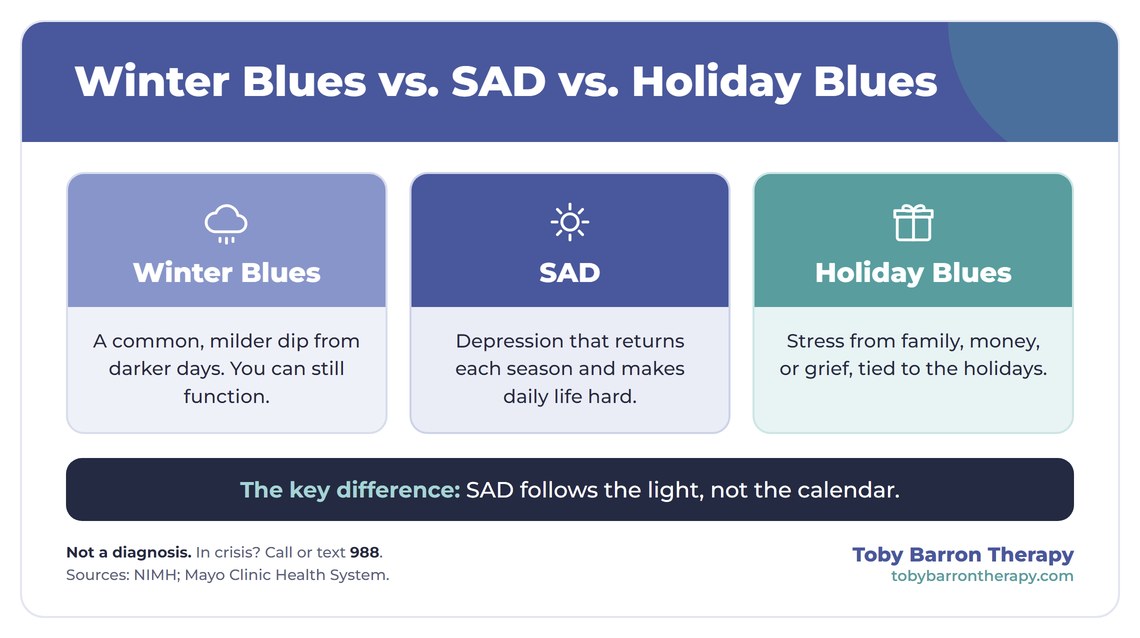
The winter blues is a common, milder dip. SAD, by contrast, involves symptoms severe enough to make it difficult to function in social, work, and home environments. The difference is largely about duration, severity, and how much your ability to function takes a hit.
The holiday blues are something else again. NIMH points out that the depression associated with SAD is related to changes in daylight hours, not the calendar, so stresses tied to the holidays or predictable seasonal changes in work, school, or family visits are not the same as SAD.
This is a time-boxed experience tied to specific stressors (family tension, financial strain, grief that gets louder in December) rather than a shift in the light itself. It can overlap with SAD, but it isn’t the same mechanism, and naming which one you’re carrying can help you respond to it more gently.
Holiday Stress for LGBTQIA+ Folks
If you’re queer or trans, the holidays can carry a weight the standard articles never mention. Maybe you’re bracing for a family gathering where you have to shrink yourself, or grieving a family that hasn’t shown up for who you are. Maybe you’re navigating chosen family logistics because the people who love you best aren’t the ones you’re related to.
That layered stress is real, and it’s distinct from a light-pattern mood shift. Minority stress (the ongoing strain of moving through a world that isn’t always safe for you) doesn’t pause for the season. When it stacks on top of a seasonal dip, the exhaustion can feel bottomless. I want you to know that what you’re carrying makes sense, and it deserves care that actually sees you.
Seasonal Depression Tips: Small Steps That Can Help You Fight Seasonal Depression
These aren’t a cure, and I won’t promise they’ll lift everything. Think of them as small, low-pressure ways to support yourself; things that might help.
Keep a loose routine. Steady wake times, meals, and movement give your body an anchor when the season is pulling at your rhythm.
Get outside early. A little morning outdoor light, even a short walk, can gently support your internal clock, a low-cost cousin of light therapy without turning your life into a routine to manage.
Stay connected to your people. Withdrawal feeds the dip. A single text to a chosen-family member counts.
Track your mood. Noticing when your low season starts each year turns a vague dread into something you can plan around.
Talk to a health care provider before self-treating. If you’re wondering about vitamin D, a light box, or an antidepressant, that’s a great conversation to have with a doctor before heading to the supplement aisle.
When does seasonal depression end?
Symptoms usually ease as the season shifts: winter-pattern symptoms tend to lift in spring, summer-pattern symptoms as fall arrives. NIMH describes winter-pattern symptoms starting in late fall or early winter and going away during the spring and summer. The exact timing varies person to person, so I won’t hand you a date.
Get Ahead of Your Low Season: Book a Free Consultation
If you’ve read this far and recognized yourself, that’s worth exploring. You don’t have to keep guessing whether what you feel is valid, and you don’t have to carry a seasonal pattern on your own year after year.
I offer affirming, LGBTQIA+-centered therapy for depression in Los Angeles, in person in Burbank and by telehealth across California. If you’d like to talk about it, I offer a free 15-minute consultation.
Whatever season this is for you, you deserve to feel like yourself in it. Get in touch!